 NomadVibes

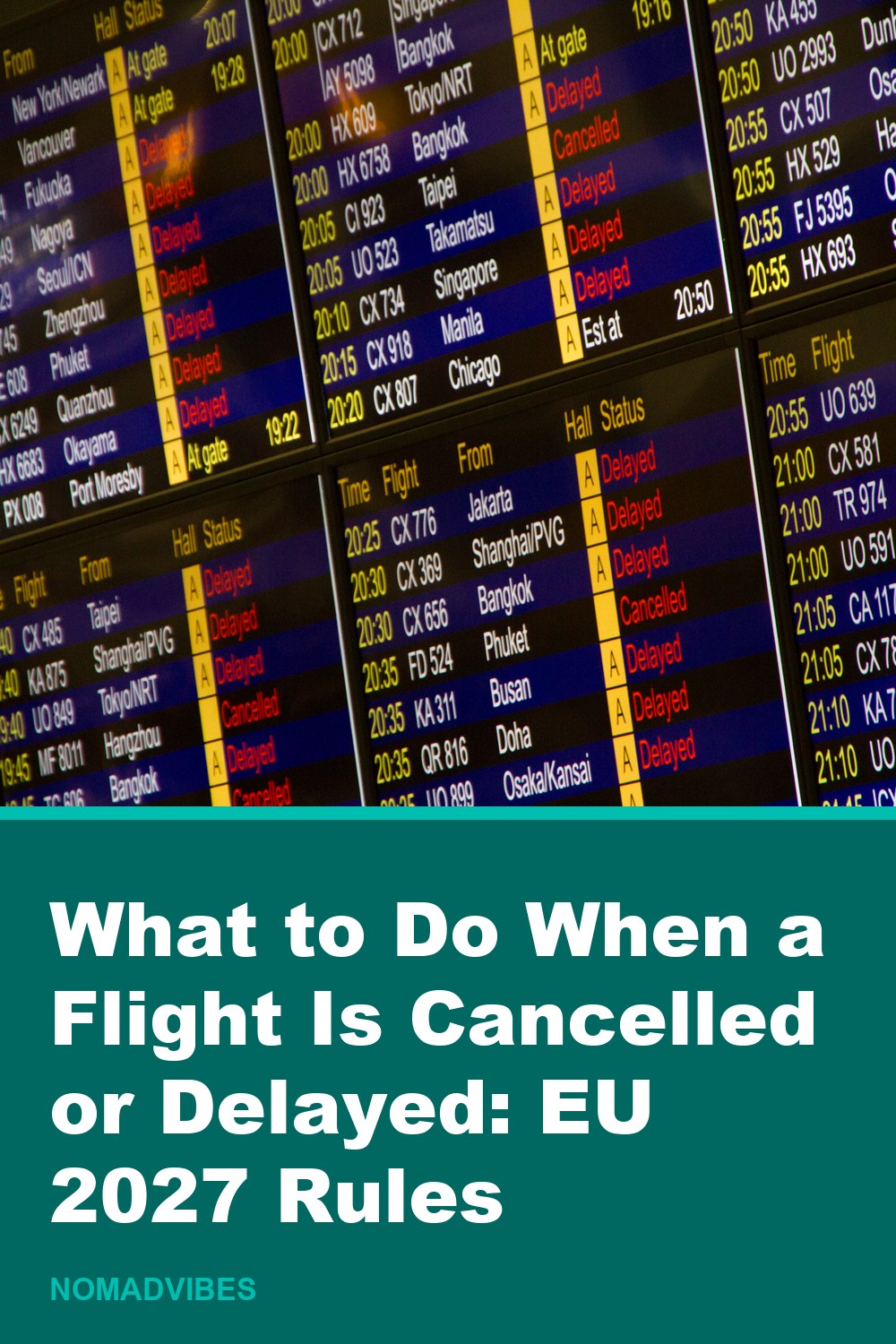

When a flight is cancelled or delayed, do four things in this order: get yourself rebooked or decide to take a refund, keep a record of everything, hold on to every receipt, and then claim. Which route you take depends on where you fly from and why the flight was disrupted. This matters now because the EU has passed its first overhaul of air passenger rights in more than 20 years. Regulation (EU) 2026/2202 entered into force on 22 October 2026, but most of it only applies from 23 October 2027. Until that date, SchengenVisaInfo reports, delays and cancellations are still handled under the existing Regulation 261/2004.
Below is a plan in phases, from the weeks before you fly to the claim afterwards. I have marked the points that are my own judgement as a long-stay traveller rather than official rules.
Phase 1 (three months before): set up your safety net when you book
Most of what saves you money in a disruption is decided at booking.
- Pay with a card that has trip delay or cancellation cover. The Points Guy notes that some rewards cards include this protection when you buy the original ticket with them. It is not guaranteed to cover every kind of disruption, so read the terms before relying on it.
- Read your travel insurance for delay cover. Policies differ, and not every situation is eligible. If you are still choosing one, our SafetyWing vs World Nomads comparison is a starting point.
- Build in buffer days. This one is my own rule: never book a flight that lands the same day as a client deadline, a check-in cut-off or a visa-sensitive date. Our post on budgeting buffer days and fares for flight disruption in Europe shows how to price that in.
- Book direct where you can. Under the new EU rules, a refund after a cancellation will include agency fees. Until then, dealing with the airline yourself is usually simpler than going through an intermediary.
Phase 2 (one month to one week before): prepare the paperwork and the tools
Install the airline's app and turn on notifications. The Points Guy says automated rebooking in the app is often faster than queuing or waiting on hold, though it does not always offer the best option, especially when many flights are affected.
Save the airline's contact details from its own app or booking confirmation, not from a search result. Our post on fake airline phone numbers on Google explains why.
Check the dates on your booking too. In the EU, a cancellation made less than 14 days before departure gives you a right to compensation, so a cancellation notice that arrives earlier than that is treated differently.
If severe weather is forecast, The Points Guy suggests rebooking before the disruption starts. Weather is typically not covered by airline guarantees, so waiting rarely improves your position.
Phase 3 (departure day): the first three hours of a delay or cancellation
Do not assume a posted delay gives you time. The Points Guy advises arriving at the airport as originally scheduled, because departure times can change quickly.
- Screenshot everything. Capture the departure board, the app notice, any email or text from the airline, and your boarding pass. Note the actual departure and arrival times.
- Try the app first, then the desk. Ask to be rebooked on the next available flight. In a big disruption, airlines sometimes publish flexible travel waivers. After a recent US nationwide ground stop that led to more than 18,000 cancellations over three days, The Points Guy reported that several airlines offered waivers, and American Airlines extended its waiver to passengers booked through Wednesday.
- Decide: rebooked or refunded. This choice affects your money, as the next phase explains.
- Keep every receipt. Meals, a hotel, a taxi: keep them all. The Points Guy says airports' nearby hotels fill quickly in a major disruption, so book early if you will be staying overnight.
- Do not buy a new flight on your own unless you are ready to absorb the cost. The Points Guy says self-booked replacement flights are usually not reimbursed. In the EU, from October 2027, there is an exception: if the airline does not offer a comparable flight within three hours of a cancellation, you can arrange your own and claim back up to 400% of the original ticket price.
Carry a charged phone, a power bank and printed copies of your documents. From October 2027, EU airlines will not be allowed to refuse boarding because you used your own printed boarding pass, but until then a printed copy is also a backup when your phone dies.
Phase 4 (arrival week): protect your work, your lodging and your visa days
This part is my own checklist, drawn from long stays rather than from any regulation.
- Message your host or hotel as soon as you know your new arrival time, so the booking is not released.
- Tell clients about the delay before a call is missed, and move any meeting in the first 24 hours.
- If your trip is inside the Schengen area, note the real date you crossed the border. Your 90/180 count runs from actual entry, so see how to track your days before every crossing.
- Put all receipts and screenshots in one folder while the details are fresh.
Phase 5 (after you land): refund, compensation or both
These are separate claims. A refund returns your ticket money. Compensation is a fixed payment for the disruption.
Refunds
Under US Department of Transportation rules, The Points Guy says, you are entitled to a full refund if your flight is cancelled or significantly delayed, whatever the reason. The catch is that it applies only if you do not accept a rebooked flight. If the airline moved your Saturday flight to Sunday and you took it, you probably cannot also get a refund.
From 23 October 2027, EU rules tighten this. Someone who chooses a refund after a cancellation must be paid automatically within seven days, including intermediary fees, and without having to ask. Vouchers are allowed only if you agree, and any unused balance must be repaid, according to law firm Burges Salmon.
EU compensation
The European Parliament says you keep the right to compensation if you arrive more than three hours late, if your flight is cancelled less than 14 days before departure, or if you are denied boarding. The amounts, which do not change under the new law, depend on distance:
- €250 for journeys of up to 1,500 km
- €400 for journeys of 1,500 to 3,500 km
- €600 for longer journeys
The new law covers flights departing from airports across the EU and Schengen area, whichever airline operates them. Burges Salmon says distance will be measured over the whole journey to your final destination, not flight by flight. On the longest journeys, airlines may halve the payment if they reroute you to your final destination, or if you arrive no more than four hours late.
The law also lists, for the first time, events that release airlines from paying. The list is open and includes natural disasters, war, weather, unruly passengers and strikes. Before this, those exemptions came from EU Court of Justice rulings. Expect airlines to cite them, so keep your evidence of the actual delay.
Meals, hotels and the claim itself
The new rules add specific waiting-time rights. You get refreshments every two hours and a meal after three hours. An overnight delay means a hotel, but only for up to three nights if the cause was outside the airline's control. On the tarmac, passengers must generally be allowed off the plane after two hours when it is safe.
For claims, the new procedure works like this from 23 October 2027:
- The airline must send electronic claim instructions within four days of the end of your journey, with no account or app required.
- You have nine months to claim.
- The airline has 30 days to pay or explain why it will not, according to the Parliament.
For a disruption before that date, the nine-month window and the four-day instructions do not apply. I would not wait; file as soon as you are home and settled.
Outside the EU
In the US, The Points Guy says airlines are unlikely to pay for hotels, ground transport and meals when the cause is outside their control, as with the FAA ground stop. Your card or insurance may still reimburse you, so keep the receipts and, as the publication puts it, you can always ask.
Why this is worth the effort
The Points Guy reports that about 2% of US flights have been cancelled so far in 2026, and that roughly one in four departures is delayed during peak travel periods. If you fly often for work and long stays, you will face this sooner or later. Having the app, the receipts, the right card and a buffer day ready costs very little compared with a missed week of work or an unplanned hotel bill.
As an Amazon Associate I earn from qualifying purchases: if you buy through these links I may earn a small commission, at no extra cost to you. Each link opens a search on the Amazon store for your country.
Watch or listen to this episode
Sources
- SchengenVisaInfo News: Flying to or From Europe? New EU Rules on Flight Delay Compensation, Automatic Refunds and a Free Personal Item From October 23, 2027
- The Points Guy: FAA meltdown: Flight cancellations ease Monday after 18,000 over the weekend
- The Points Guy: Flight canceled or delayed? Here’s what to do next
Photo: Oscar Chan / Pexels

I'm an Italian creator who builds apps, games and websites. I run NomadVibes with the help of AI tools: every article starts from the sources linked above, and I check what goes out. I'm not a doctor, a lawyer or a financial adviser. Spotted a mistake or have an idea? Write to me.
Instagram @spartaco_94_My websiteWrite to meAbout this blog









 Pronunciation Perfection: How to Sound Like a Native Speaker
 Reinventing Yourself After 40: A Guide to Embracing Change and New Beginnings
 Personal Branding for Introverts: How to Shine Without Shouting





