 NomadVibes

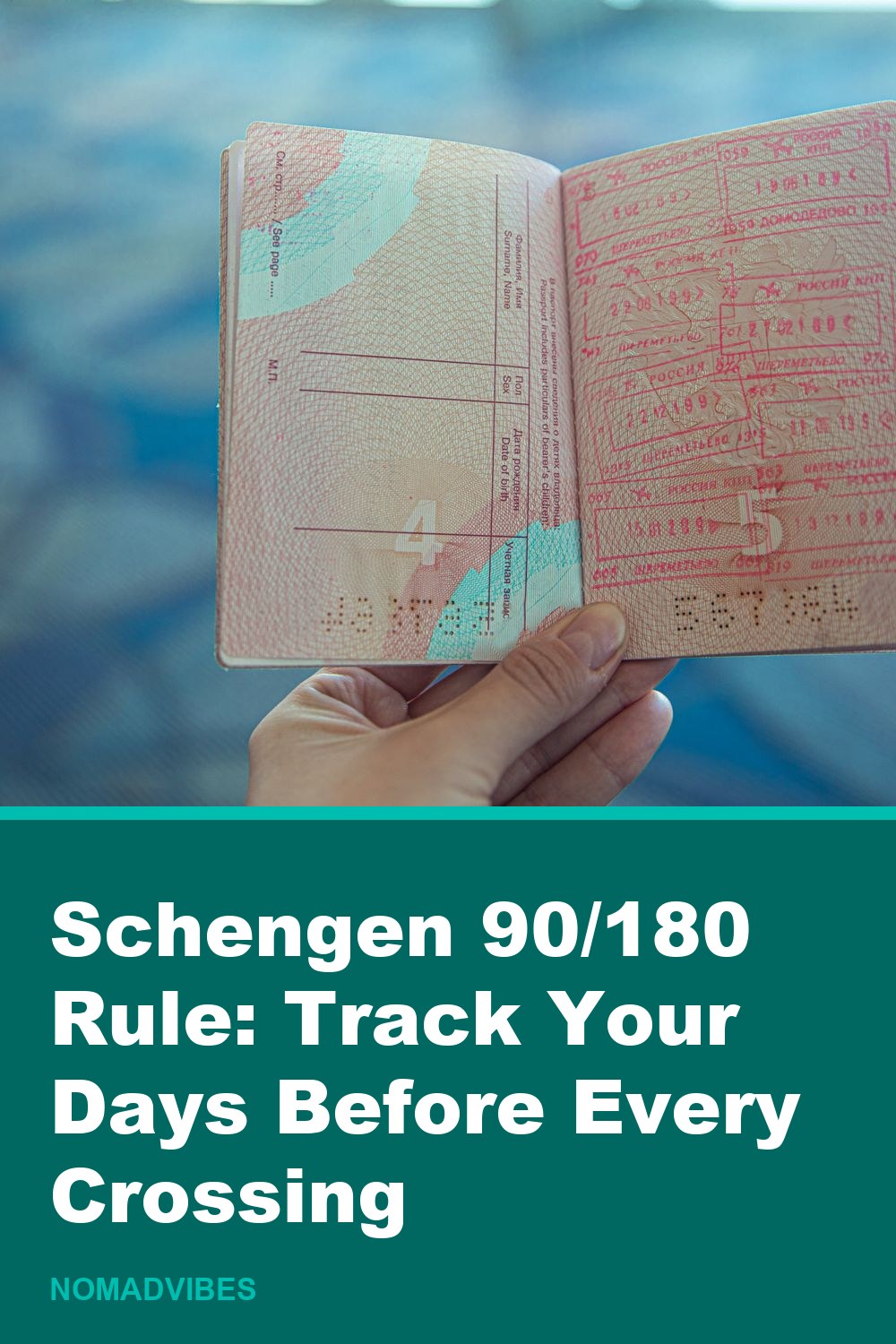

In 2025, EU border guards refused entry to 22,455 people because they had already used their 90 days in a 180-day period. According to SchengenVisaInfo.com's analysis of Eurostat data, that is 16.9% of all 132,600 refusals, roughly one in six. For anyone who spends months at a time in Europe, the lesson is simple: count your days before every border crossing, not only before the long trips.
What the rule says, in plain terms
Travellers without a residence permit or long-stay visa can spend at most 90 days in the Schengen Area in any rolling 180-day period. The Schengen Borders Code counts both the day you arrive and the day you leave as days of stay.
The clock is shared across every Schengen country. Ten days in Italy and ten days in Croatia make twenty days on one clock, not two. A border guard who finds you have no days left can refuse you entry even if your passport and visa are valid and your trip is ordinary. Eurostat records this reason as “person already stayed 3 months in a 6-months period”.
The window is rolling, so there is no fixed date when your days reset. For each day of a planned stay, you look back over the 180 days before it and add up every day you spent in the zone.
How refusals for overstaying compare with other reasons
The 90-day limit is now the second most common ground for refusal. It was sixth in 2018 and third in 2024. Only doubts about the purpose of the trip are ahead of it.
| Reason for refusal (EU, 2025) | People refused |
|---|---|
| Unjustified purpose of the trip | 40,185 |
| Already stayed 90 days in 180 | 22,455 |
| No valid visa or residence permit | 20,340 |
| All reasons combined | 132,600 |
These figures come from Eurostat and are rounded to the nearest five. In absolute terms, refusals for this reason rose from 18,530 in 2018 to a peak of 22,590 in 2024, then dipped slightly. The share grew faster because refusals for other reasons fell after 2019.
Who is being caught, and what that tells a nomad
Be careful reading these numbers. SchengenVisaInfo.com reports that most of the people refused come from countries near the EU's eastern and south-eastern borders, whose citizens travel visa-free and often cross several times a year. Ukrainians account for 12,190 of the 2025 refusals, or 54.3%. Poland reported 12,120 of the total, followed by Romania (2,235), Croatia (2,010) and Italy (1,240).
None of this is a refusal rate. Eurostat counts people refused, not people checked, so a busy crossing produces more refusals even if the guards are no stricter.
So the data does not say that remote workers are being singled out. But it shows what happens to people who cross repeatedly and lose track of the arithmetic, and that describes plenty of slow travellers who hop between Schengen countries and the Balkans, the UK or Turkey.
Why the Entry/Exit System changes the game for counting
The Entry/Exit System (EES) replaces passport stamps with a digital record of each entry and exit. It calculates the days you have used automatically, so a guard no longer has to count stamps to spot an overstay.
The early numbers suggest it works. In its 2026 State of Schengen Report, published on 18 May 2026, the European Commission said more than 30,000 refusals had been recorded in the EES and that almost 7,000 travellers were denied entry for having overstayed. Those figures run to 20 April 2026, and the Commission said the system had been fully deployed at all border crossing points on 10 April.
The first quarterly report from eu-LISA, the agency that runs the system, shows 19,985 refusals between January and March 2026. Of those, 4,353 were people who had already stayed three months in a six-month period, again second only to an unjustified trip purpose. The EES figures are not directly comparable with Eurostat's, because they cover a partial roll-out, a different period and a wider group of countries, including Norway and Switzerland.
For you, the practical point is that your days are now on record at every crossing. A rough guess no longer works, and neither does hoping nobody counts.
What this means for you: a pre-crossing checklist
Do this before you book, and again before you cross.
- Keep your own log. Write down every entry and exit date for the Schengen Area, with the country. Don't rely on stamps, since the digital record is replacing them.
- Count arrival and departure days. Both count as days of stay, so a trip from the 1st to the 10th is ten days, not nine.
- Look back 180 days from each day of the planned stay. Not from today only, and not from the start of the trip only.
- Add all countries together. Italy, Croatia and every other Schengen state share one allowance.
- Exclude residence-permit or long-stay-visa time. According to SchengenVisaInfo.com, that time does not count towards the 90 days.
- Build in a margin. Don't plan to exit on your very last allowed day. A delayed flight or a missed ferry is then a nuisance, not an overstay.
- Re-check before every crossing. Short hops into a non-Schengen country and back start a new entry but do not reset the count.
- Use a calculator to confirm. SchengenVisaInfo.com offers a short-stay calculator, but keep your own log as the base record.
If you will need more than 90 days in any 180, look at a long-stay visa or residence permit for a single country well before you run out of days. Time spent on one of those sits outside the short-stay count.
Why paper procedures will be around for years
If you need a Schengen visa rather than travelling visa-free, don't expect a single smooth online system soon. The EU Visa Application Platform, a single website or app for applications to any Schengen country, is expected to start operating around 2030, according to the European Commission. eu-LISA, the agency building it, has set an earlier internal target of 2028, but neither date is legally binding.
Once it opens, Member States may keep their current procedures for up to seven years. According to SchengenVisaInfo.com, that means some countries could keep their existing application systems until about 2037, and a paper procedure will remain possible in exceptional cases afterwards.
Even when the platform arrives, some in-person steps stay. Applicants must still appear in person for a first application with a new passport, or if their fingerprints were taken more than 59 months earlier. The standard fee has been €90 for adults since 11 June 2024. So if you change passports or your fingerprints are old, plan consulate time into your schedule.
FAQ
Does the 90/180 rule reset after I leave the Schengen Area?
No. The 180-day window rolls forward day by day. Days drop out of the count only when they are more than 180 days behind the day you are checking. Leaving for a short time does not wipe your record.
Do the days I spend in different Schengen countries add up?
Yes. The limit is shared across all Schengen countries. Ten days in Italy and ten days in Croatia count as twenty days against the same 90.
Can I be refused entry even with a valid passport?
Yes. A border guard who finds you have no days left can refuse entry even if your passport and any visa are valid and your trip is otherwise ordinary. In 2025, about one in six refusals across the EU's external borders was for this reason.
Sources
- SchengenVisaInfo News: One in Six People Refused Entry to the EU in 2025 Had Already Used Their 90 Days
- SchengenVisaInfo News: Online Schengen Visa Applications: EU Platform Expected Around 2030, With Paper Procedures Possible Until the Late 2030s
Photo: Ekaterina Belinskaya / Pexels

I'm an Italian creator who builds apps, games and websites. I run NomadVibes with the help of AI tools: every article starts from the sources linked above, and I check what goes out. I'm not a doctor, a lawyer or a financial adviser. Spotted a mistake or have an idea? Write to me.
Instagram @spartaco_94_My websiteWrite to meAbout this blog









 Pronunciation Perfection: How to Sound Like a Native Speaker
 Reinventing Yourself After 40: A Guide to Embracing Change and New Beginnings
 Personal Branding for Introverts: How to Shine Without Shouting





